Orders containing live food and other arthropods are shipped within Italy only on Mondays, Tuesdays, and Wednesdays each week. Please read the Shipping and Delivery terms carefully before placing your order. On-site pickup is always available: order online and come visit us at our warehouses in Cerea (VR).


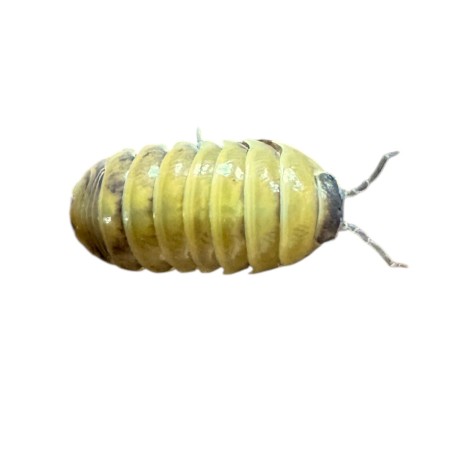
Starter colony of 10 specimens of mixed sizes: Armadillidium Casteldaccia yellow ground isopods, also known as badium high yellow.
Lively and fascinating, native to the Mediterranean regions, particularly Malta and Sicily, these invertebrates can reach dimensions of up to 2 cm and are distinguished by their intense coloration and the yellow band that colors their exoskeleton.
Together with other easy-to-manage species, the casteldaccia are very prolific and resistant, these isopods are particularly suitable for those who are new to the experience (Difficulty 1/5).
• Customers are advised that the purchased pieces may be grouped together in one package in order to optimize space. Orders with isopods are shipped ONLY on Monday, Tuesday and Wednesday.•
ATTENTION: upon receipt of shipments, place the packages containing isopods in a medium temperature environment for at least an hour (20/22°C) before opening them, so that they adapt to the climate difference. Below or above these temperatures, the isopods will appear to be less reactive, give them time to adapt before decanting them.
In nature they live on the ground of woods and forests, hidden among trunks and rocks. In your bioactive terrariums you should try to recreate this habitat. The substrate should be created with a mixture of leaves, soil and rotten wood to provide basic food. A layer of moss and sphagnum, pieces of bark and other leaves should be placed on the substrate, so that on one side the animals can find shelter and on the other the substrate does not dry out too quickly.
Food: fruit, vegetables, flowers, mushrooms, molds, Collembolafix Springtail Feed, Various leaves.
Temperature: They are also active at temperatures of 18/20 ° C, a good management temperature is around 24 ° C, This temperature reflects the warm environment typical of their Mediterranean habitat and promotes an active metabolism, better reproductive capacity and regular growth. Establishing and maintaining a constant temperature is important to avoid stress and problems resulting from temperature changes.
Humidity: They like a humid environment, humidity should be maintained between 50%.
Terrarium: To create an ideal environment, it is advisable to use a terrarium that reflects their natural habitat. Key elements to consider:
- Size: a moderate container, of about 3-5 liters, is sufficient for a small colony, providing space for movement and reproduction.
- Ventilation: the terrarium must ensure good air circulation to avoid stagnation that could cause excessive humidity.
- Substrate: use untreated organic soil or a mixture of coconut and vegetable fiber, enriched with dry leaves and decomposed bark.
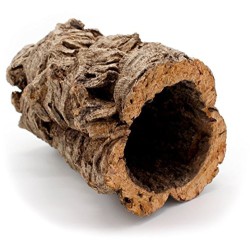
- Natural shelters: insert small hiding places such as logs, slightly hollowed stones or moss, to reproduce the natural microenvironment and offer protection to the isopods.
You can safely keep them together with snails and slugs, millipedes, phasmids, beetles, etc. If instead you decide to include them as detritivores for cleaning your terrarium with reptiles and amphibians you must take into account that they could become a succulent snack rich in calcium and chitin;
The isopods decompose the organic waste material of your animals inside the terrarium, keeping it always clean, also creating high-quality humus for your plants. Being detritivores they do NOT feed on live plants, so there is no problem that they can eat healthy plants in your habitat.
You might also like
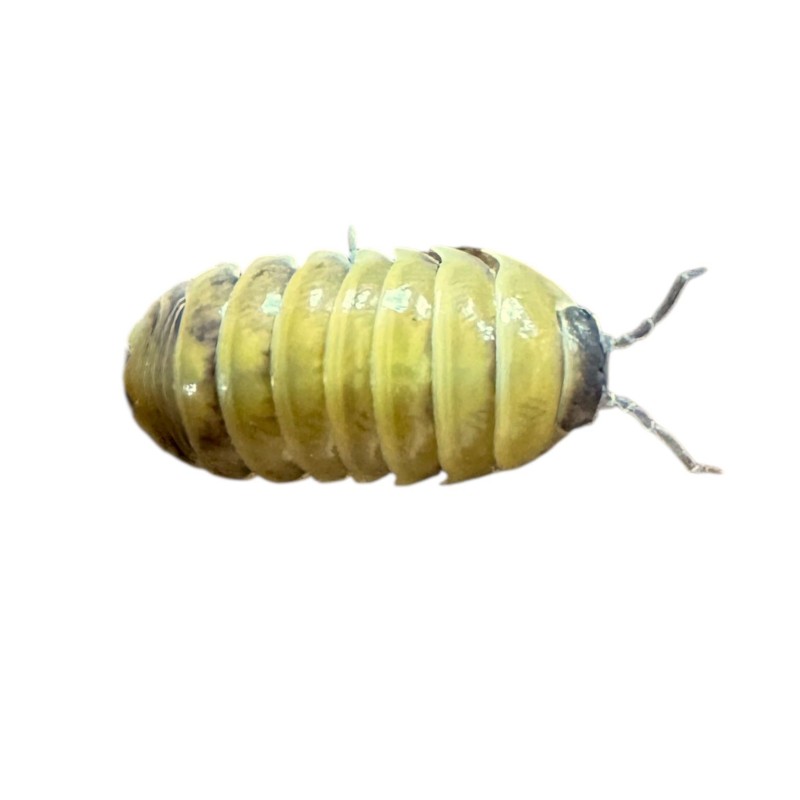
Starter colony of 10 specimens of mixed sizes: Armadillidium Casteldaccia yellow ground isopods, also known as badium high yellow.
Lively and fascinating, native to the Mediterranean regions, particularly Malta and Sicily, these invertebrates can reach dimensions of up to 2 cm and are distinguished by their intense coloration and the yellow band that colors their exoskeleton.
Together with other easy-to-manage species, the casteldaccia are very prolific and resistant, these isopods are particularly suitable for those who are new to the experience (Difficulty 1/5).
• Customers are advised that the purchased pieces may be grouped together in one package in order to optimize space. Orders with isopods are shipped ONLY on Monday, Tuesday and Wednesday.•
ATTENTION: upon receipt of shipments, place the packages containing isopods in a medium temperature environment for at least an hour (20/22°C) before opening them, so that they adapt to the climate difference. Below or above these temperatures, the isopods will appear to be less reactive, give them time to adapt before decanting them.